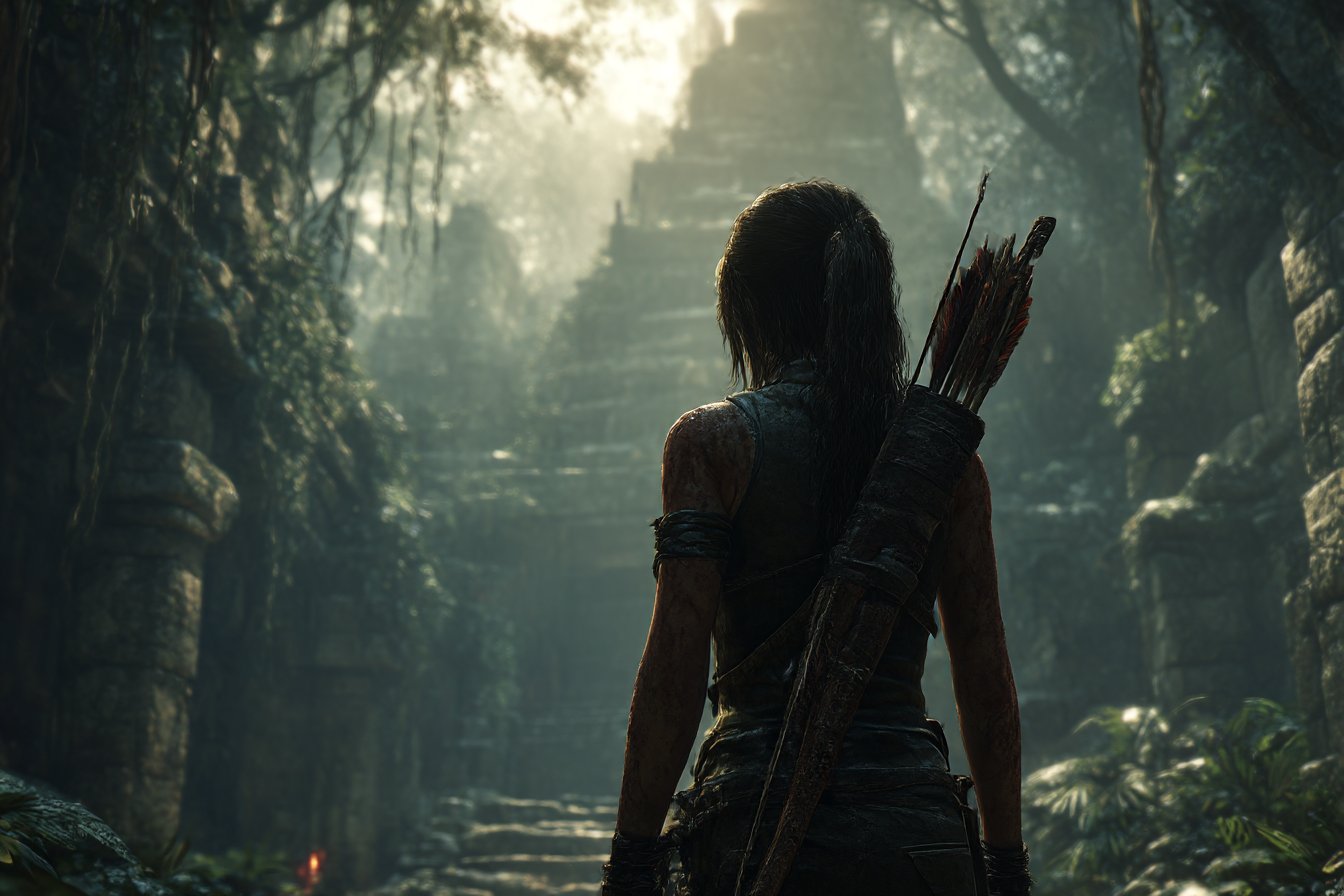

We’ve all had those obsessions that seem ridiculous, yet continue to pull us in. For me, it’s Tomb Raider — specifically, how one series has held onto me since 1996, the year I graduated from college, and continues to haunt me to this day, with me in my 40’s, teaching high school kids about the American Revolution.
I’ll never forget the first time I walked into an Electronics Boutique (remember those?) trying to decide if I wanted to spend $60 on a new PS1 game. A guy with a goatee (a haircut that all game store guys wore in the ’90s) notices me staring at the Tomb Raider cover and says, “It’s kinda like Indiana Jones, but with better moves and more puzzles.” That sold it for me. I had no clue I was getting into a long-term relationship with a series that would outlive many of my actual relationships.
My first apartment after college was… well, the security deposit was optional. I had my PS1 perched on a milk crate because a real entertainment centre costs money I didn’t have. I’m sitting cross-legged on a carpet that’s seen things I don’t want to even think about. When the theme music kicks in, and the camera pans around Lara in that first Peru level, I felt something click. I hadn’t felt that kind of genuine adventure since playing the original Zelda as a kid and still had surprises about how large games could be.
The movement system of the early Tomb Raider games totally blew my mind. Jumping in games before Tomb Raider was generally binary — you either landed it or you didn’t. But Lara moved like a gymnast. Remember the first time you successfully ran and jumped and caught a ledge and rolled to safety? Man, that felt revolutionary. Of course, it also killed me about 47 times in the first hour because the grid-based movement required math skills I definitely did not have. I quickly figured out that “good enough” was not going to cut it when you’re jumping across ancient death traps.
The puzzles in the original Tomb Raider games had this perfect simplicity that somehow made them complex. Push lever, move block, time jump — but you had to study your environment and think about the layout in a way that most games do not require. I spent what felt like hours stuck in the City of Vilcabamba, knowing there was a key somewhere, but completely unable to find it. When I saw that tiny crack in the ceiling that indicated a climbable surface — and led to a hidden room with the key I needed — I felt like both a genius and an idiot at the same time.
St. Francis’ Folly is still probably the best thing Core Design has ever made. A huge vertical shaft with puzzle rooms for different gods — Damocles, Thor, Atlas, Neptune — and you could look down from the bottom and see where you needed to go. The path to the top was this intricately designed puzzle/precision jump sequence that took forever to learn. When I finally made it to the top, I stood up and danced in my tiny living room. The guy downstairs pounded on his ceiling, which I interpreted as congratulations.
The dual pistols became Lara’s trademark for a reason. The auto-targeting feature allowed for flipping and rolling around enemies while the sound design — that hollow echo off stone walls — is as iconic as Mario’s jump sound. When Anniversary came out and kept the classic weapons, but updated everything else, it felt like they understood what made the original great.
Can we talk about those save crystals for a second? While they were simultaneously the best and worst thing about early Tomb Raider. The glowing blue crystals were like finding water in the desert, and I celebrated each one far more than any rational adult should. However, their scarcity created a tension that modern games can’t replicate. I remember being short on health, making significant progress since my last save, and having to decide whether to risk pushing forward or backing up to safety. More than once, I left my PlayStation on overnight because I’d gotten to a challenging section without finding a crystal, and I couldn’t bear the loss of my progress.
Managing limited resources and item combinations in the early games was part of the challenge. Deciding whether to use a small medipack now, or save it for later — modern regenerating health has destroyed all that strategic decision-making. I actually miss agonizing over whether I really needed to heal right now, or if I could make it to the next supply.
Chronicles introduced a new mechanic — that Colosseum level where you could see the structure in both its ruined state in the present, and its former glory in the past. Being able to solve puzzles that showed you the effects of changes in one time period on others felt innovative. I wound up drawing notes on a legal pad to help me understand how the changes in one time period affected another — which felt like being an actual archaeologist, not just someone with fast reflexes.
I’ll be honest — when Core Design lost the reins after Angel of Darkness (which I won’t rant about), I was worried. I didn’t know if Crystal Dynamics would betray the essence of the series. When Legend came out, I was proven completely wrong. They took the series to modern standards, streamlined the controls and level design, and still managed to retain that sense of loneliness and discovery.
That first view of the massive King Arthur statue in Legend felt like the same awe I experienced when I first saw St. Francis’ Folly.
Tomb Raider II’s Great Wall sequence is where the series really hit its stride. I spent an entire weekend playing through those levels fueled by pizza and Mountain Dew (the official fuel of 90s gaming marathons). I was blown away by how the designers expanded the space without sacrificing anything that worked. The contrast between cramped interior corridors and open spaces on top of the wall created this rhythm that kept me engaged for hours. When it shifted to Venice, I remember thinking, “How much game was on that disc?” Finding multiple unique environments in one game today seems quaint, but back then, it felt almost ridiculously generous.
Lara’s development as a character over the years has been fascinating to watch. Early Lara was more of an archetype than a person — aristocratic, capable, distant, with a lot of implied backstory that was never developed. By the time of the 2013 reboot, she was a full-fledged character with plenty of growth while retaining the core of what made her appealing. Watching her take her first human kill and be visibly shaken — it was like watching a franchise grow up with its fans. I wasn’t that college kid playing for fun anymore; I was a grown-up who appreciated the emotional depth.
The cinematic moments have evolved as well. The spectacular moments in the early games were exciting, but were born from gameplay rather than carefully crafted as scripted events. The later games — particularly the ones handled by Crystal Dynamics — have been increasingly cinematic and the final three games in the reboot trilogy have combined the spectacle of Uncharted with the traditional exploration of the older games. That slide down the mountain in the 2013 game would’ve been impossible to achieve on the original PS hardware, but it captured the same thrill-seeking danger that hooked me from the start.
Venice’s Opera House in Tomb Raider II remains one of my favorite gaming areas of all time. The combination of architectural majesty, underwater exploration, and vertical travel created a playground that encouraged thorough investigation. I recall surfacing in the centre of the Opera House and seeing all the balcony and catwalks overhead, and simply spending time studying the area and planning my approach. How they incorporated flooding as both a navigational obstacle and a narrative device felt advanced for the time period, and has influenced other games in this genre.
Underworld struck a nice balance with its multi-chamber mechanical puzzles that functioned based on internal rules that you had to discover. That large Mediterranean section with the giant water-control system spanning multiple chambers required you to think about the entire space as interconnected. I wound up sketching out diagrams on paper to visualize how individual components interacted — something I hadn’t done since those original game days. That higher-level thinking, feeling like the game trusted my intellect to give me complex problems without holding my hand too tightly, has always been the best version of Tomb Raider.
As I reflect on how my gaming habits have changed since the ’90s and how the series itself has evolved, it’s easy to see that the fundamental draw of discovering ancient, abandoned places and uncovering their secrets remains strong to this day. My students may find it odd that their History teacher is enthusiastic about fictional archaeology, but honestly? Tomb Raider has taught me more about spatial reasoning and problem-solving than most of my college classes. Wherever Lara goes next, I will follow. Some obsessions are worth the investment.
Those original technical limitations created an atmosphere that later entries sometimes struggle to recreate. Empty, echoing corridors, ambient sounds of dripping water or howling wind, complete isolation broken only by rare animal noises — it felt like genuine archaeological discovery, despite the obvious fantasy elements. Later games included NPCs, complex narratives, more crowded environments, and gained sophistication, but lost that particular sense of total isolation in abandoned places.
I’ve purchased every major Tomb Raider title at release, and I’ve continued this tradition with fewer franchises. I’ve watched Lara grow from that initial archetype into a fully-realised character with genuine progression, while maintaining the aspects that made her compelling. The dual pistols gave way to bows and climbing axes, fixed cameras to third-person free-roaming, and static animation to motion capture, but the heart of the series remained — a brilliant, capable, and independent woman exploring exotic locations filled with history and mystery.
Crystal Dynamics perfectly refined their Tomb Raider formula in Underworld’s Coastal Thailand level. Seamlessly integrating swimming, climbing, and puzzle-solving, the level featured an underwater cave exit revealing an ancient ruin beautifully lit with numerous methods of traversing the terrain — it encapsulated everything I love about the series from the start. Standing on that beach, gazing up at the cliff faces and ruins, I felt the exact same excitement as in 1996, sitting on the floor of my apartment, meeting Lara Croft for the first time.
I sometimes ponder what gaming would look like without Tomb Raider’s influence. The third-person action-adventure genre, environmental puzzle design, and cinematic presentation — so much of that was pioneered or perfected by Lara’s adventures. Modern Uncharted and God of War games have clearly borrowed ideas from Tomb Raider.
Playing Shadow of the Tomb Raider, the conclusion to the reboot trilogy, I was reminded of the decades-long journey that I’ve shared with Lara. The series had returned full-circle to emphasizing exploration and solving puzzles, while keeping the focus on character development and production quality of modern gaming. Swimming through flooded Incan temples, I felt echoes of those first Peru adventures — now powered by technology that would have been impossible to achieve in 1996.

John grew up swapping floppy disks and reading Amiga Power cover to cover. Now an IT manager in Manchester, he writes about the glory days of British computer gaming—Sensible Soccer, Speedball 2, and why the Amiga deserved more love than it ever got.
0 Comments