You know how sometimes a piece of plastic can trigger a complete emotional meltdown? I'm talking full-scale, grown-man-nearly-crying-in-a-charity-shop territory. That happened to me last month when I spotted a copy of TMNT: The Hyperstone Heist wedged between a dusty copy of Ecco the Dolphin and someone's old FIFA '94. The cart was slightly yellowed, had that particular smell of old plastic that's been stored in someone's loft for twenty years, and the label had a tiny corner peel that made my collector's heart wince. But seeing those four turtle faces again…man, it was like being punched in the stomach by nostalgia.
I grabbed it immediately, obviously. Paid the three quid without haggling because the volunteer behind the till looked like she'd rather be anywhere else, and I didn't want to risk someone else swooping in. Got home, cleaned the contacts with my usual ritual of isopropyl alcohol and cotton buds (I go through more cleaning supplies than a hospital ward), and slotted it into my trusty old Mega Drive. That familiar Konami logo appeared, followed by the turtle power theme that's been lodged in my brain since 1992. Suddenly I was thirteen again, carpet burns on my knees from leaning too close to the telly, arguing with my younger brother about who got to be Donatello.
The thing about TMNT beat 'em ups on the Genesis is they occupy this weird space in gaming history where everything just clicked. Konami had already proved they could make brilliant arcade brawlers with games like Crime Fighters and Vendetta, but when they got their hands on the Turtles license, something magical happened. The Hyperstone Heist wasn't just a lazy cash grab based on a cartoon – it was a proper, meaty beat 'em up that understood what made the arcade originals so addictive.
I remember the first time I played Turtles in Time at our local bowling alley. The cabinet sat right next to the snack bar, and the combination of cheese toasties and turtle power created this perfect storm of childhood bliss. Four-player simultaneous action was still relatively rare in 1991, and watching four kids crowd around that cabinet, all mashing buttons and shouting at the screen, was pure theatre. But here's the thing – most of us couldn't afford to pump enough coins into arcade machines to actually finish these games. They were designed to eat money, not to be conquered.
That's where the home conversions became so important. The Hyperstone Heist gave us the full meal deal at home. Sure, it wasn't a direct port of the arcade games – Konami actually built this one specifically for home consoles, borrowing the best bits from both the original TMNT arcade game and Turtles in Time. The sprite work was gorgeous, properly chunky pixels that made each turtle feel distinct and weighty. Leonardo's katanas had this satisfying swish to them, Michelangelo's nunchucks created these beautiful arc patterns, Raphael's sai felt brutal and precise, and Donatello's bo staff had incredible reach that made crowd control an absolute joy.
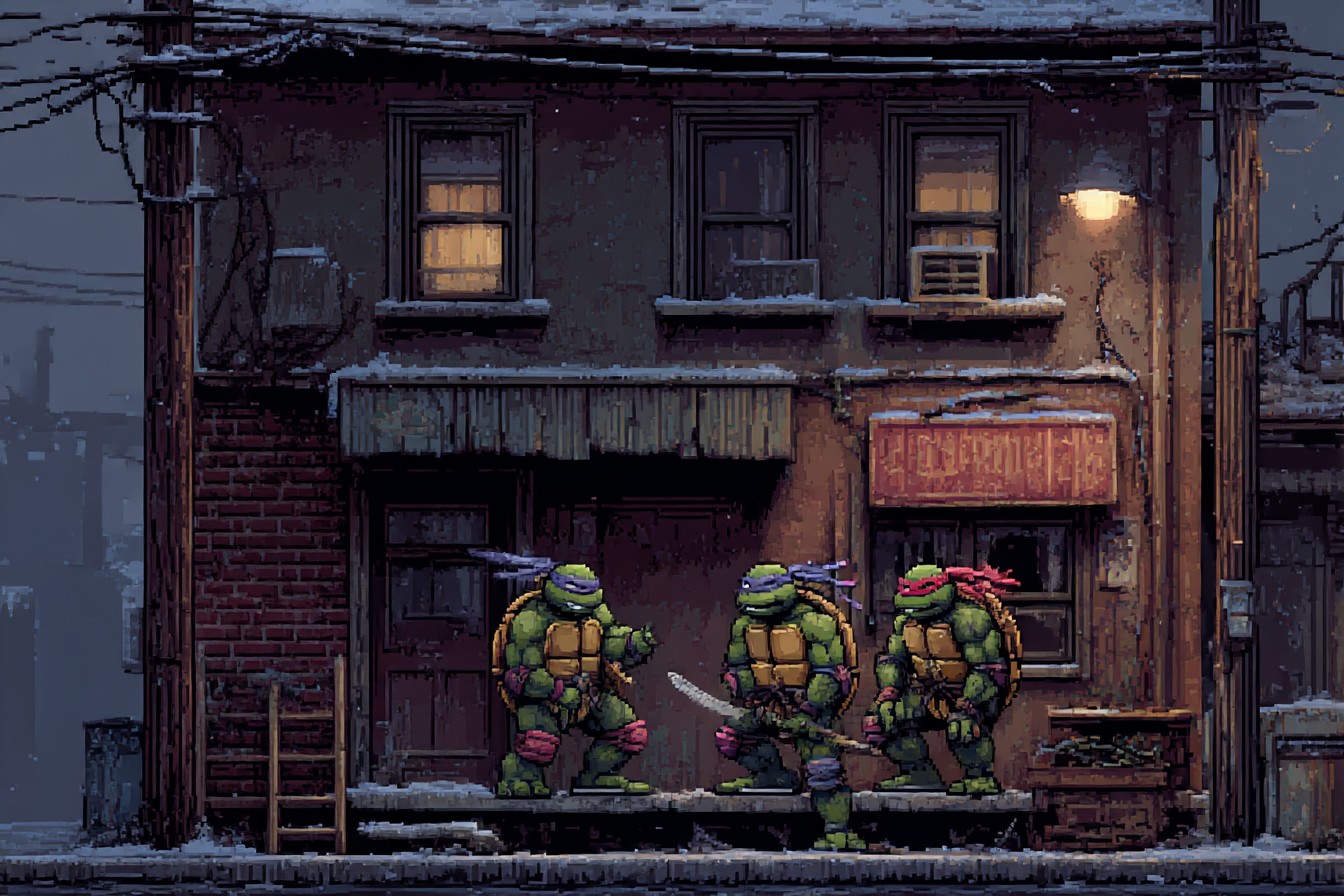
The sound design still gives me goosebumps. That Yamaha YM2612 chip in the Mega Drive had this particular metallic twang that made every sound effect feel like it had been forged in some electronic foundry. When you connected with a combo, the audio feedback was so satisfying you'd find yourself deliberately setting up chains just to hear that distinctive crack-pop-thwack sequence. The music was pure early '90s energy – not quite the arcade soundtrack we knew and loved, but perfectly suited to the home experience. That main theme still gets stuck in my head for days after I play it.
But what really made these games special was the co-op experience. Split-screen was fine for racing games and such, but there was something about standing shoulder-to-shoulder with a mate, both of you facing the same screen, working together to clear rooms full of Foot Soldiers that created genuine camaraderie. You'd develop these unspoken strategies – I'll grab this guy while you deal with those two, or you take the left side of the screen while I handle the right. When one of you was in trouble, the other would instinctively move to help. It was gaming at its most social, before we all got headsets and started shouting at strangers on the internet.
The level design was brilliant too. Each stage had its own personality – from the burning apartment building where you'd occasionally have to dodge falling debris, to the technodrome sequences that felt genuinely alien and threatening. The bosses weren't just damage sponges either; they had patterns you could learn, weaknesses you could exploit, and enough personality to make each encounter feel like a proper duel rather than a button-mashing endurance test.
I've got to be honest though – playing these games solo never quite captured the same magic. Beat 'em ups are fundamentally social experiences, and while the AI in Hyperstone Heist was decent enough to provide a challenge, it couldn't replicate that unpredictable human element that made four-player sessions so chaotic and brilliant. There's something about having three other people all trying to grab the same pizza power-up that creates this beautiful competitive cooperation that single-player just can't match.

These days, I fire up Hyperstone Heist on my MiSTer setup (connected to that same Trinitron that's been with me since university), and the muscle memory kicks in immediately. My fingers still know exactly when to jump-kick, when to throw, when to use the special moves that drain your health but clear the screen in spectacular fashion. The game holds up remarkably well – the pacing is still spot-on, the difficulty curve still feels fair but challenging, and the sheer joy of battering through waves of identical enemies never gets old.
What strikes me most about revisiting these games is how confident they were. There's no hand-holding, no tutorial explaining every mechanic, no achievement notifications breaking the flow. You pick up a controller, start hitting buttons, and within thirty seconds you're fully immersed in being a ninja turtle. The game trusts you to figure things out, to experiment, to get better through practice rather than exposition.
That copy I found in the charity shop is now sitting proudly on my shelf, right next to my other Genesis classics. Every time I walk past it, I smile a little. Because somewhere in that yellowed plastic cartridge lives a piece of my childhood – the memory of summer holidays spent perfecting combos, of birthday parties where four-player Turtles was the main event, of learning that sometimes the best games aren't the most technically impressive ones, but the ones that understand fun at its most elemental level.
Cowabunga, indeed.



