Picture this: you're thirteen, it's 1991, and your mate's older brother just walked through the door with a black plastic case that looks like it could house nuclear launch codes. Inside? Sonic the Hedgehog for the Mega Drive. We didn't know it then, but we were about to witness the birth of speed as a gameplay mechanic, wrapped in attitude and served with a side of "blast processing" that we'd argue about for decades.
Fast-forward to 2024, and I'm hunched over my desk with a cup of tea that's gone cold twice, firing up the Sonic Genesis Collection on Steam. The irony isn't lost on me—back then, we'd have killed for perfect arcade-quality ports of every Sonic game ever made, available instantly without cartridge-swapping or arguments over whose turn it was. Now that we have exactly that, I find myself missing the ritual of blowing dust from plastic slots and the satisfying click of a cart sliding home.
But here's the thing about the Sonic Genesis Collection: it's bloody brilliant, even if it makes me feel ancient. We're talking about the complete original trilogy plus Sonic & Knuckles, Sonic 3D Blast, and even Sonic Spinball—all running through what appears to be a proper Mega Drive emulator rather than those dodgy mobile ports that made Sonic look like he'd been put through a washing machine.
The first time I loaded up Green Hill Zone, that opening guitar riff hit me like a brick. Not just the nostalgia—though there's plenty of that—but the realization that this music still absolutely slaps. Masato Nakamura's compositions for the original games weren't just catchy; they were architectural. Each zone had its own sonic fingerprint, and hearing them through proper stereo speakers instead of tinny TV audio reveals layers I'd never noticed as a kid.
Speaking of audio, can we talk about how the collection handles the Mega Drive's distinctive sound chip? That YM2612 FM synthesis that made everything sound slightly metallic and aggressive—it's all preserved here. The bass drop in Casino Night Zone still rattles my subwoofer the same way it rattled my parents' telly back in '92. Meanwhile, the sound effects retain that particular Sega crunch: the ring collection chime, the jump sound, the spin dash charge-up that became as iconic as Mario's coin grab.
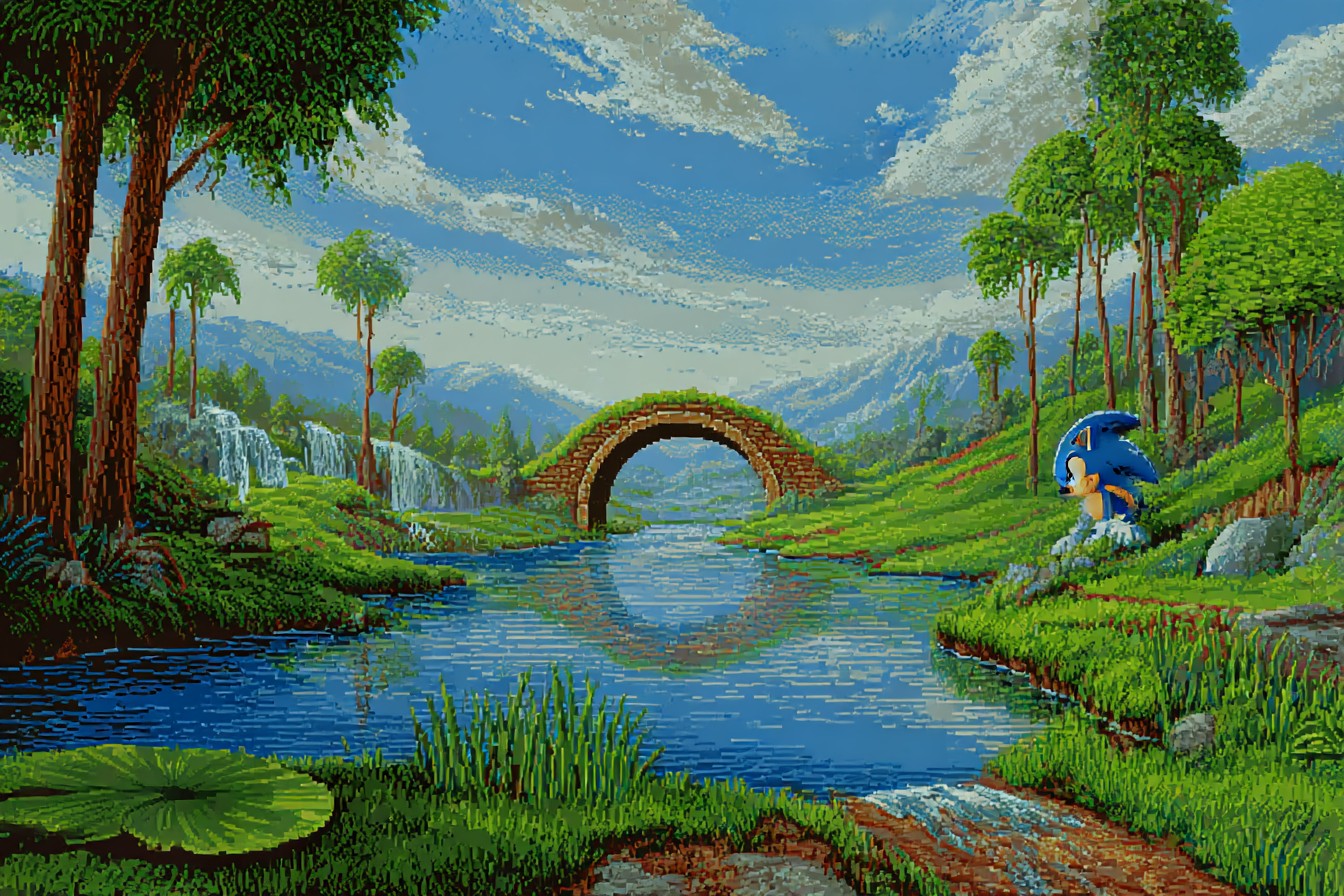
What really impressed me, though, was discovering games I'd completely missed first time around. Take Sonic 3D Blast—I remember dismissing it as "not proper Sonic" because it wasn't side-scrolling. Turns out teenage me was an idiot. Playing it now with adult patience (and save states, because I'm not nineteen anymore), it's actually a clever isometric puzzle-platformer with gorgeous pre-rendered sprites and some of the best music on the system. Richard Jacques composed a soundtrack that sounds like what would happen if Yuzo Koshiro had a jazz fusion phase.
The collection's rewind feature is a godsend for someone whose reflexes have been gradually betraying him since the PlayStation 2 era. You can practice those precise Chemical Plant Zone water sections without wanting to throw a controller through the window. More importantly, it lets you appreciate the level design without the frustration. Those loops and corkscrews aren't just showing off—they're carefully crafted speed puzzles where momentum equals progress.
And let's be honest about Sonic games: they were never just about going fast. That was marketing speak. The best moments came from learning each level's rhythm, finding the optimal path through interconnected routes, building up speed through skill rather than just holding right. The collection preserves all of this perfectly, with crisp pixels that scale beautifully on modern displays and input lag that feels identical to original hardware.
I've been particularly impressed with how well Sonic & Knuckles holds up. Remember lock-on technology? Connecting two cartridges together felt like hacking the Matrix in 1994. Here, it's seamless—you can play Sonic 3 & Knuckles as the complete experience it was always meant to be, with save files that actually work and a soundtrack that includes all those Michael Jackson-adjacent compositions that were supposedly too expensive to license properly back in the day.
The extras are where this collection really shines, though. Concept art, music galleries, behind-the-scenes documentaries—it's like having access to Sega's archives. There's footage of developers explaining level design philosophy that makes you realize how much thought went into making a blue hedgehog feel fast without actually moving that quickly across the screen. It's all about animation frames, parallax scrolling, and sound design working in perfect harmony.

My kid wandered over while I was playing Chemical Plant Zone the other day, drawn by the music. Within minutes, she was asking if she could try. Watching her discover these games fresh—no preconceptions, no nostalgia goggles—was fascinating. She immediately understood the physics in ways that felt intuitive, found secrets I'd missed after decades of play, and laughed at Robotnik's facial expressions like they were brand new comedy gold.
That's the real test of any retro collection: does it work for people who weren't there the first time? With Sonic, the answer is absolutely yes. The gameplay holds up because it was never really about the technology—it was about feel. The satisfaction of a perfectly timed jump, the musical reward of collecting rings in sequence, the visual comedy of Sonic's impatient animations when you stop moving.
Sure, there are minor complaints. The menu system could be slicker, and I'd love more granular video options for us CRT enthusiasts. But these are quibbles with what's essentially a perfect preservation of gaming history. Every ring collected, every loop-de-loop traversed, every "way past cool" attitude perfectly intact.
Playing through this collection reminded me why Sonic mattered beyond the console wars and playground arguments. These weren't just Mario alternatives—they were expressions of pure kinetic joy, games that made speed feel like freedom. In 2024, when everything moves too fast anyway, that feeling hits different. Sometimes you need a blue hedgehog to remind you that the best kind of rushing around has purpose, rhythm, and a really good soundtrack.



