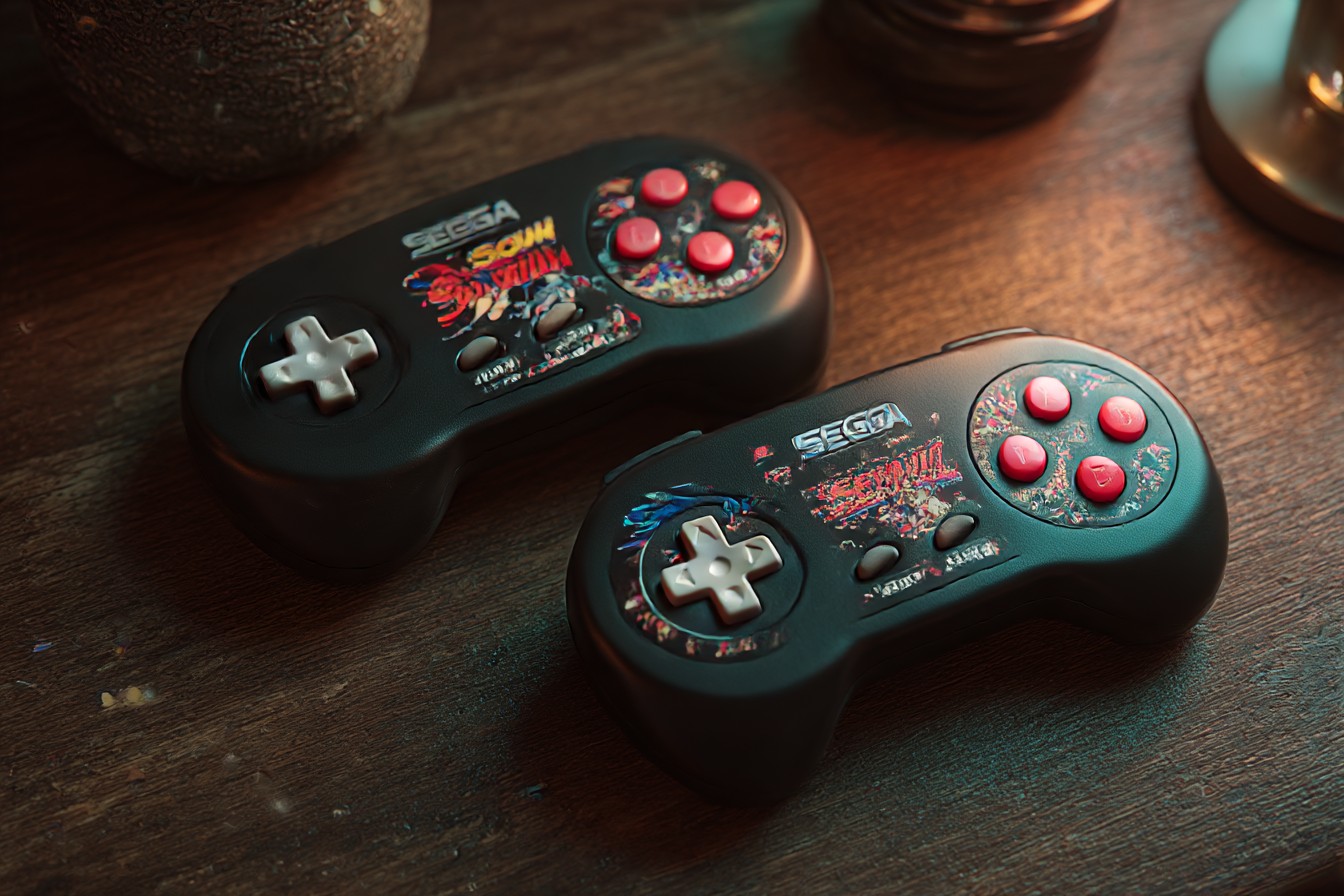
There's something magical about the weight of a Sega Genesis six-button controller in your hands. I mean, really—you pick one up today and it still feels like holding lightning. Not the thin, weightless plastic of modern controllers, but something with heft. Something that meant business.
I discovered this back in '92 when Street Fighter II Championship Edition landed on the Genesis. My mate Dave had convinced his mum to spring for the six-button pad bundle, and honestly? It changed everything. Up until that point, we'd been making do with the standard three-button controller, trying to execute hadokens with punch and kick buttons mapped to the same triggers. It was like trying to play piano with mittens on.
But that six-button layout… Christ, it was revelation wrapped in grey plastic.
You've got to understand the context here. This was peak fighting game fever. Every corner shop had kids practicing quarter-circle motions on imaginary joysticks, muttering "down, down-forward, forward, punch" under their breath like some kind of mystical incantation. The arcade scene was absolutely mental—queues of 10p coins lined up on Street Fighter II cabinets, everyone waiting their turn to get properly thrashed by that one kid who somehow knew every single combo.
When you brought that experience home with the Genesis six-button controller, it didn't feel like a compromise. It felt like having the arcade right there in your living room. The button spacing was perfect—your thumb naturally rested between light and medium punch, with heavy punch just a quick stretch away. The kick buttons sat exactly where your thumb wanted them to be. None of this awkward reaching or finger gymnastics that plagued other home conversions.
I remember the first time I successfully pulled off Chun-Li's spinning bird kick using that controller. Dave and I had been practicing for hours, getting increasingly frustrated with the timing. Then suddenly—click—it all made sense. The muscle memory just locked in. The controller wasn't fighting against what you wanted to do; it was helping you do it.
What's brilliant about the Genesis six-button pad is how the ergonomics actually improved on the arcade stick layout. Arcade cabinets had those big, chunky buttons that required proper finger placement and deliberate presses. The Genesis controller translated that feel into something more intimate. You could rest the controller against your leg, grip it with both hands, and your thumbs would naturally fall into the perfect position for any fighting game.
The D-pad deserves special mention too. That distinctive cross shape with the slightly raised center—it gave you proper tactile feedback for quarter-circle and half-circle motions. You could feel exactly where neutral was, which made charge moves like Guile's sonic boom so much more reliable. I spent countless hours perfecting that charge timing, holding back for what felt like forever before snapping forward and hitting punch. The D-pad never let me down.
Fatal Fury Special was another game that absolutely sang on that controller. Terry Bogard's power wave, Andy's flying kick—everything felt crisp and responsive. There was this satisfying click when you nailed a special move, both from the controller feedback and the game's audio design. It created this perfect loop of tactile and auditory satisfaction that kept you coming back for more.
But it wasn't just about fighting games, really. That six-button layout made the controller surprisingly versatile. I used it for everything—platformers, shoot-em-ups, even puzzle games. The extra buttons gave developers more options, and players more control. Streets of Rage 2 let you assign different attacks to different buttons, creating this satisfying rhythm of punches and kicks that felt like conducting violence with your thumbs.
The build quality was something else entirely. These weren't the fragile, plasticky affairs we'd grown used to. The Genesis six-button controller felt like it could survive a nuclear winter. The buttons had this lovely resistance to them—not mushy like some controllers, but firm and responsive. You could hammer on them during intense matches without worrying about breaking anything.
I still have my original six-button pad from '92. The plastic's gone slightly yellow with age, and the cable's developed that peculiar stiffness that old electronics get, but it works perfectly. Every button still clicks with authority. The D-pad still centers with mechanical precision. It's outlasted three different Genesis consoles and countless hours of punishment.
What strikes me now, looking back, is how ahead of its time that controller was. We take six-face-button layouts for granted these days, but in the early '90s, it was genuinely innovative. Sega recognized that fighting games needed more than the standard setup, and they designed hardware specifically to accommodate that need. It wasn't just an afterthought or a cash grab—it was purposeful design that enhanced the gaming experience.
The weight distribution is something modern controllers still struggle with. That Genesis six-button pad had perfect balance. You could hold it for hours without hand fatigue, which was crucial during those marathon fighting game sessions. The grip was wide enough for adult hands but not so bulky that kids couldn't use it comfortably.
There's also something to be said for the simplicity of it all. No analog sticks to drift, no triggers to stick, no wireless connectivity to drop out at crucial moments. Just solid, reliable digital controls that did exactly what you told them to do, when you told them to do it. Pure, unfiltered gaming input.
These days, when I fire up Street Fighter II on my original hardware, using that same six-button controller, it still feels absolutely perfect. The muscle memory kicks in immediately. The timing, the spacing, the feedback—it all comes flooding back. That controller didn't just enable great gaming experiences; it became part of them.
Modern fighting game controllers try to recapture that magic, and some succeed better than others. But there's something irreplaceable about the original Genesis six-button pad. It wasn't just a controller—it was the key that unlocked an entire generation's love affair with fighting games.



