The Christmas of '97 still haunts my wallet. I'd been saving pocket money for months, doing extra chores that my mum definitely didn't need done but tolerated anyway because she knew what I was after. The N64 had been out for a year, and every kid at school was either bragging about Mario 64 or lying about having played it at their cousin's house.
What I wasn't expecting was DOOM. Actual, proper, demons-and-shotguns DOOM on a Nintendo console. The same company that made me blow into Zelda cartridges was now letting me blast cacodemons in the living room where we watched Coronation Street.
I'd played DOOM before, obviously. Everyone had. It lived on every PC in every computer lab, passed around on floppy disks like contraband literature. But console DOOM? That felt impossible. The N64 version landed like a meteorite in 1997, and honestly, it shouldn't have worked. The hardware wasn't built for it, the controller was designed by aliens, and Nintendo's family-friendly image meant seeing the ESRB M rating on a first-party cartridge felt like spotting a unicorn.
But work it did, sort of. Williams Entertainment—those pinball wizards—somehow squeezed id Software's masterpiece onto a 32MB cartridge. Thirty-two megabytes. I've got photos on my phone bigger than that entire game. They had to gut levels, compress audio until it sounded like it was being played through a tin can, and rebuild the whole thing from scratch. The result was DOOM, but DOOM wearing a slightly ill-fitting suit.
The first thing you noticed wasn't what was missing—it was that four-controller port staring at you from the front of the console. Four-player split-screen DOOM. In 1997. On hardware that was already sweating trying to run GoldenEye at a steady framerate. It was ambitious to the point of recklessness, and I loved every chunky, pixelated frame of it.
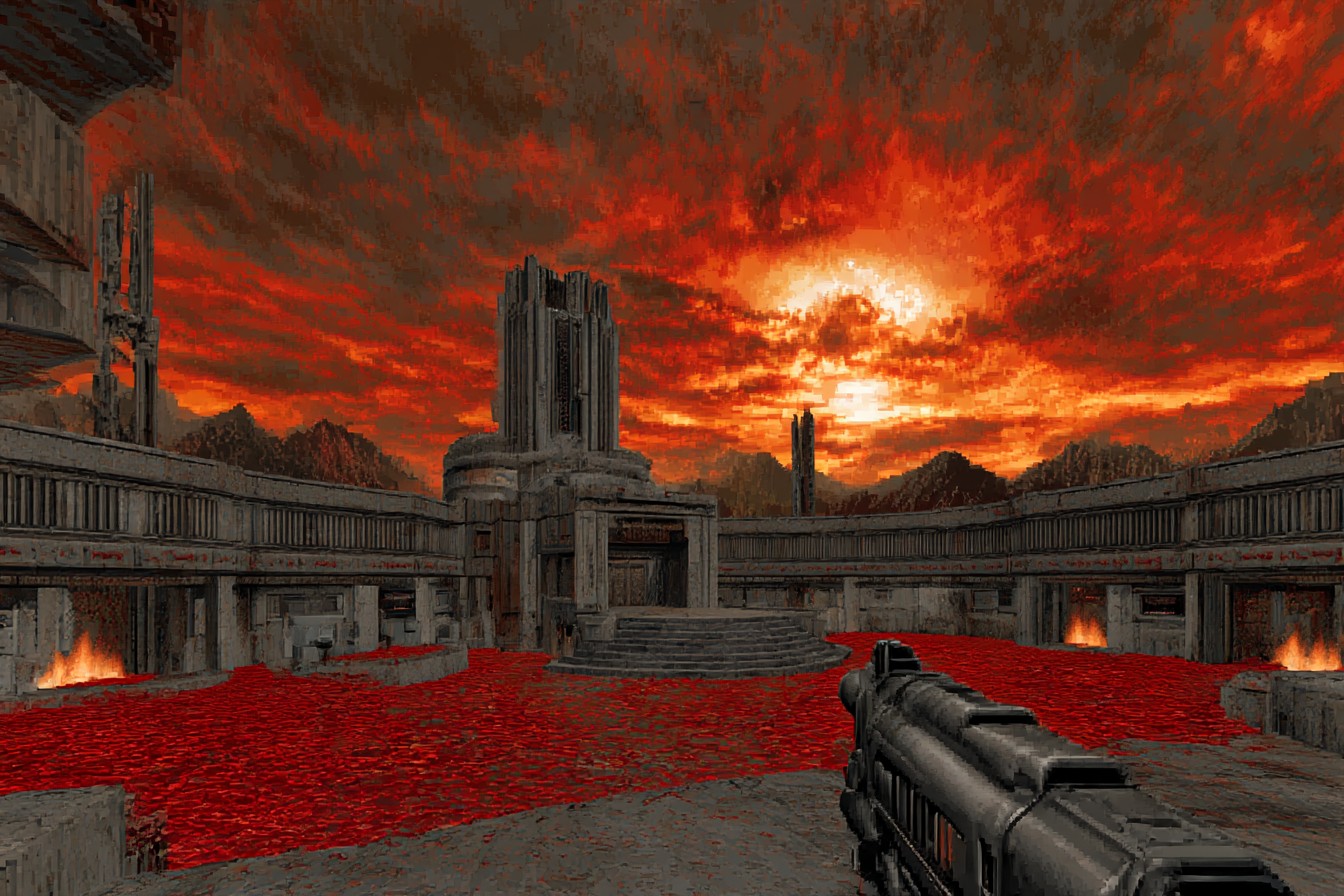
My mates and I spent entire weekends hunched around our 28-inch CRT, squinting at quarter-screen views that turned demons into abstract art. The frame rate would tank whenever more than two cacodemons showed up, but we didn't care. We were playing DOOM on a sofa, with proper controllers, without having to negotiate computer time or mess about with DOS commands. The convenience factor was revolutionary, even if the technical compromises were obvious to anyone who'd experienced the PC original.
The N64 controller, bless its three-pronged heart, was never designed for first-person shooters. The C-buttons handled strafing duties while the analog stick did the heavy lifting for movement and turning. It felt like learning to write with your wrong hand, but muscle memory is a beautiful thing. Within a few sessions, we were circle-strafing imps and rocket-jumping like we'd been born to it. The Z-trigger became our best friend—that satisfying click as you squeezed off shotgun blasts or held down for the chaingun's metallic chatter.
What really impressed me wasn't the technical wizardry, though that was remarkable enough. It was how they'd adapted the original's 28 levels into something that worked for console play. The pacing felt different—more deliberate, less frantic than the PC version's relentless forward momentum. Levels were condensed but retained their essential character. E1M1 still felt like E1M1, even if it looked like it had been through a photocopier a few too many times.
The multiplayer modes were where the N64 version truly found its identity. Deathmatch was obvious, but they'd also included cooperative play through the campaign. Nothing bonds friendships quite like reviving your mate after they've been flambeaten to death by a Hell Knight. The split-screen format meant constant screen-peeking, obviously, but that became part of the strategy. Knowing where your opponent was spawning, which weapons they were grabbing, whether they were heading for the rocket launcher or playing it safe with the shotgun.
Sound design took a hit in translation, naturally. The N64's audio capabilities were decent for their time, but nowhere near what a decent PC sound card could deliver. The demons' roars became tinny growls, the shotgun lost its meaty boom, and the music—oh, the music. Bobby Prince's legendary DOOM soundtrack, that perfect fusion of metal riffs and midi wizardry, came across like a cover band playing through a telephone. It worked, just about, but anyone who'd experienced the original knew what was missing.
Visually, the compromises were everywhere. Texture resolution dropped significantly, detail sprites disappeared, and the lighting effects that made the PC version feel genuinely atmospheric were simplified almost to the point of abstraction. But here's the thing—it still looked like DOOM. The red brick corridors of the UAC facility, the hellish caverns of later episodes, the iconic demon designs—all recognizable despite the technical limitations.
The real achievement was getting it running at all. The N64's architecture was notoriously difficult to develop for, with its unusual memory setup and custom Reality Engine graphics chip. Williams Entertainment essentially had to rebuild DOOM's engine from the ground up, optimizing every routine for hardware that was never meant to handle this type of game. The fact that it maintained a playable framerate most of the time borders on miraculous.
Loading times were non-existent, obviously—cartridge perks. Pop the cart in, flick the power switch, and you were chainsawing demons within seconds. No CD-ROM delays, no installation hassles, just instant gratification. That immediacy made it perfect for quick sessions when you had twenty minutes before dinner or wanted to squeeze in a quick deathmatch before homework.
The N64 DOOM port represents something important in gaming history—the moment when console hardware became powerful enough to attempt serious PC ports, even if the results weren't always pretty. It paved the way for Quake 64, for the later console versions of Unreal Tournament, for the entire ecosystem of console FPS games that followed. Without this slightly wonky, technically compromised, utterly charming version of DOOM, we might never have gotten Halo, Call of Duty, or any of the other console shooters that define modern gaming.
I still fire it up occasionally, usually when I want to remember what gaming felt like before online multiplayer and patch downloads and season passes. Four controllers, one cartridge, a bunch of mates arguing over who gets the BFG. Simple times, when bringing hell to the living room just meant convincing your parents that video game violence was probably fine as long as you kept the volume down during EastEnders.



